 Skip to content
It’s like exercise, but for your brain. Engage in educational topics related to memory, participate in mental/physical exercise, learn memory techniques/ strategies and enjoy social support, creativity and laughter.
Classes are offered three times a week for 5 hours, with lunch provided each session. Each day consists of a structured curriculum with a variety of topics. We will incorporate brain games, exercise, and social stimulation. Studies have proven that people who engage in complex tasks (exercising your brain) can significantly lower the risk of Dementia including improving the cognitive function of the brain. The Mayo Clinic study done in 2009 reported that people who engaged in mentally challenging activities in their 50’s and 60’s were 40% less likely to suffer memory problems.
Video Transcript
HOST: And welcome back. Well, we know that we need to exercise our bodies to stay in shape, but today we’re talking about a program that’s like exercise for your brain.
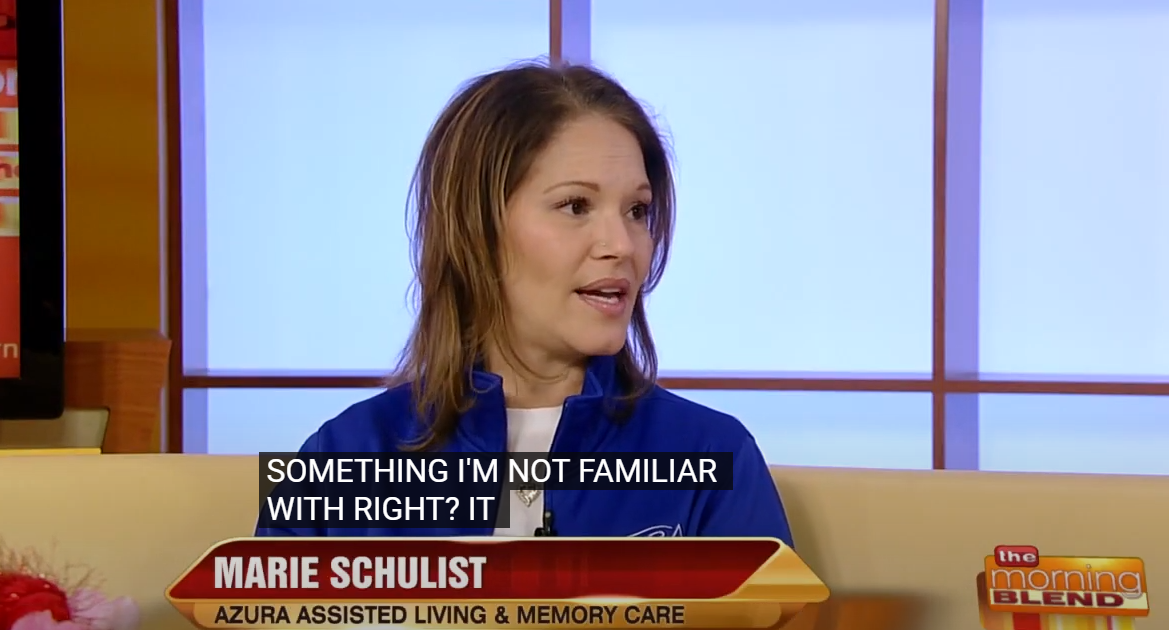
Joining us now is Marie Schulist from Azura, an assisted living and memory care community, to talk about their new TIME program for those who want to keep their minds sharp. I love that part of it. Good morning to you.
MARIE: Good morning. Thanks for having me.
HOST: The TIME program is something I’m not familiar with, right?
MARIE: It is brand new to Missouri. It was originally called Early Memory Loss, and we decided to rename it TIME. TIME stands for Tessera Integrated Memory Enhancement.
Basically, we’re working with a company out of Florida called IMAP, which is going to provide our curriculum. It’s designed to help those who are in the early stages of memory loss keep their minds functioning and keep their minds going, so they can live a little bit longer without experiencing all of the memory loss that can come with dementia.
HOST: Cool. So, is this class specifically for people with dementia? Is that who is eligible to participate?
MARIE: Yes and no. We encourage anyone who wants to participate. A caregiver absolutely could, too. But, you know, you might want to look at it for someone who’s more in their 50s and 60s rather than just a caregiver.
You want the person to be able to exercise their mind and get their brain moving by doing different curriculum activities that we’re going to be doing, along with some exercises and getting our bodies involved as well.
HOST: I like that. The whole-body approach.
MARIE: Yeah. Action is so important.
HOST: Why are you offering this early memory loss program? Why is it something that you see as being valuable and important?
MARIE: Sure. As a community, we have a lot of memory care communities and a lot of loved ones out there. When they see someone who is suffering with potential Alzheimer’s or dementia, even at the onset, they right away want to go and look at memory care communities.
This is a step before that memory care community, so they have the ability to continue to work with their mind until it gets to a point where maybe that move actually needs to happen.
Just that idea of exercising your brain can significantly lower some of the risks associated with dementia or improve cognitive function in the brain.
HOST: Absolutely.
So, is the program similar to an adult day program, or is that different?
MARIE: No, the program is completely different. It’s structured. Every day is going to have a structure with it.
There will be content where we’re going to do brain exercises — a lot of brain exercises. That could be crossword puzzles, Sudoku-type things, word-finding exercises, those types of things.
We’ll do some exercises with that and then incorporate our bodies with exercise as well.
Adult day programs aren’t really structured in the same way. This has an actual structured curriculum.
HOST: Is it something you’re currently offering, or is this — because I know it’s new — something that’s coming in the future?
MARIE: Missouri does not currently offer this, right. It is something that’s coming. March 7th will be our first debut of the program, so we’re super excited to get going with it.
It is new to the Fox Point location right now.
HOST: Here’s the deal: This is something that’s truly research-based. It’s not just like you came up with this idea and thought it was a good idea. There are some real studies behind it, including some out of the Mayo Clinic, right?
MARIE: Yeah. In 2009, the Mayo Clinic did a study that stated those in their 50s and 60s were 40% less likely to suffer from early memory loss just by keeping your mind and your body moving.
HOST: A huge percentage.
MARIE: It’s huge. It is huge, for sure.
HOST: Wow. Yeah.
You mentioned when the program will launch. How many people are you able to accommodate as part of it?
MARIE: It’s going to be popular.
To be honest with you, I already have one person signed up.
HOST: Fantastic!
MARIE: The good thing is we have eight spots. I’ve got seven open now.
It will be small, so it will be intimate. It’s not going to be a classroom-like setting. We’ll be at a table together, so we’ll all be working together.
HOST: And not that you would be up there teaching, you know—
MARIE: Ha-ha, you know.
HOST: The days and times that this will be offered — somebody would need to be retired or have the time available, I assume?
MARIE: Yes. The days are Tuesdays, Wednesdays and Thursdays from 10:00 a.m. to 3:00 p.m. We will have lunch included.
Really, it’s for those who might have someone experiencing early memory loss, but they don’t have to be with them. It’s like, drop them off, I’ll entertain them. We’ll do little brain activities, we’ll do some exercises, and then you pick them up at the end of the day.
So really, you can look at it like it’s respite care for some of those who need it.
HOST: Oh, I was just going to say that.
With the information we’re about to share, there are informational sessions about the program that starts on March 7th. We just want to make that clear.
MARIE: Yes.
HOST: And I wanted to say, some of the stuff that they learn — it feels like this could then be practiced at home.
MARIE: Absolutely. They will be given content that they can take home with them. A caregiver, spouse, loved one or family member can go over this stuff with them as well.
HOST: That’s great. You can tell you’re excited.
So nice to meet you.
MARIE: Nice to meet you. Thank you.
HOST: Thanks for being here.
And here is the Azura Assisted Living & Memory Care information, because they’re holding three informational sessions about the TIME program.
The first one is via Zoom. It’s on Monday, February 20th, if you want to find out more. Then the other two are in person at the Fox Point location on North Port Washington Road. Those are on February 23rd and February 25th.
For more information, call the number on your screen. You can also email Murray….
Contact Marie to schedule a free class or RSVP for the info session!
Marie Schulist, MOSAIC & Engagement Specialist
marie@azuraliving.com, or call 414-758-0394.
Info Sessions:
February 20th at Noon on Zoom – head to azuraliving.com/events to access link
February 23rd at 5 PM in person – 7770 N. Port Washington Rd. Fox Point
February 25th at 10 AM in person – 7770 N. Port Washington Rd. Fox Point
Still not sure about the T.I.M.E. Program? Here is more information on the importance of cognitive stimulation!
Cognitive stimulation for individuals with memory loss can involve various activities that help keep the brain active and engaged, such as:
- Mind games: Playing brain-training games and puzzles, such as crosswords, sudoku, and memory matching games, can help stimulate the brain and improve memory.
- Social interaction: Engaging in social activities, such as joining a club or group, volunteering, or visiting with friends, can provide mental stimulation and help boost memory.
- Physical activity: Regular physical activity, such as walking or doing yoga, can improve blood flow to the brain and increase cognitive function.
- Learning new skills: Trying new activities or learning a new skill, such as knitting or playing a musical instrument, can provide mental stimulation and challenge the brain.
- Reading and writing: Engaging in activities that stimulate the brain, such as reading and writing, can help improve memory and cognitive function.
It’s important to note that cognitive stimulation should be customized to each individual’s interests and abilities for maximum benefit.